The ducks have arrived, but from where? Nemours is helping support research led by Dr. Mike Schummer and graduate student, Izzy Eagen, at the State University of New York College of Environmental Science and Foresty (ESF), aimed at determining the origins of gadwall, wigeon, and green-winged teal harvested in the Atlantic Flyway.
These three duck species are common in coastal South Carolina in winter and make up a significant proportion of the state’s annual waterfowl harvest. Understanding their origin and migration routes is important for effective waterfowl conservation. Although South Carolina lies within the Atlantic Flyway, traditional pre-season waterfowl banding data suggests that many of the ducks harvested in South Carolina come from breeding areas west of the Atlantic Flyway like the Prairie Pothole Region in the Dakotas and southern Canada. While some waterfowl do breed in eastern Canada, they occur at lower densities and across vast areas, making banding and deriving population estimates challenging. This gap may lead to underestimating eastern Canada’s role in supporting waterfowl populations for Atlantic Flyway states.
To address this, the team at ESF is using innovative techniques, including stable isotope analysis of feathers from hunter-harvested ducks. Here’s how it works: when a young duck grows its first flight feathers, the local environment leaves a unique stable isotopic “signature” in those feathers. That signature stays with the bird until it molts, allowing researchers to estimate how far north a bird harvested in winter was hatched. Combining this latitudinal data with winter banding records helps determine the proportion of ducks harvested in South Carolina that originated east or west of James Bay in Canada.
In addition to financial support, Nemours is collecting wings for the project from ducks harvested on-site and partnering with others to gather samples from additional properties in the ACE Basin and Georgetown area. Last season over 300 wings were collected statewide, and with the current season in full swing, we’re working to expand that dataset even further. This project extends beyond South Carolina, and we’re eager to see what trends are uncovered across the entire Atlantic Flyway.
This post was written by Stephen Clements, Wildlife Scientist.
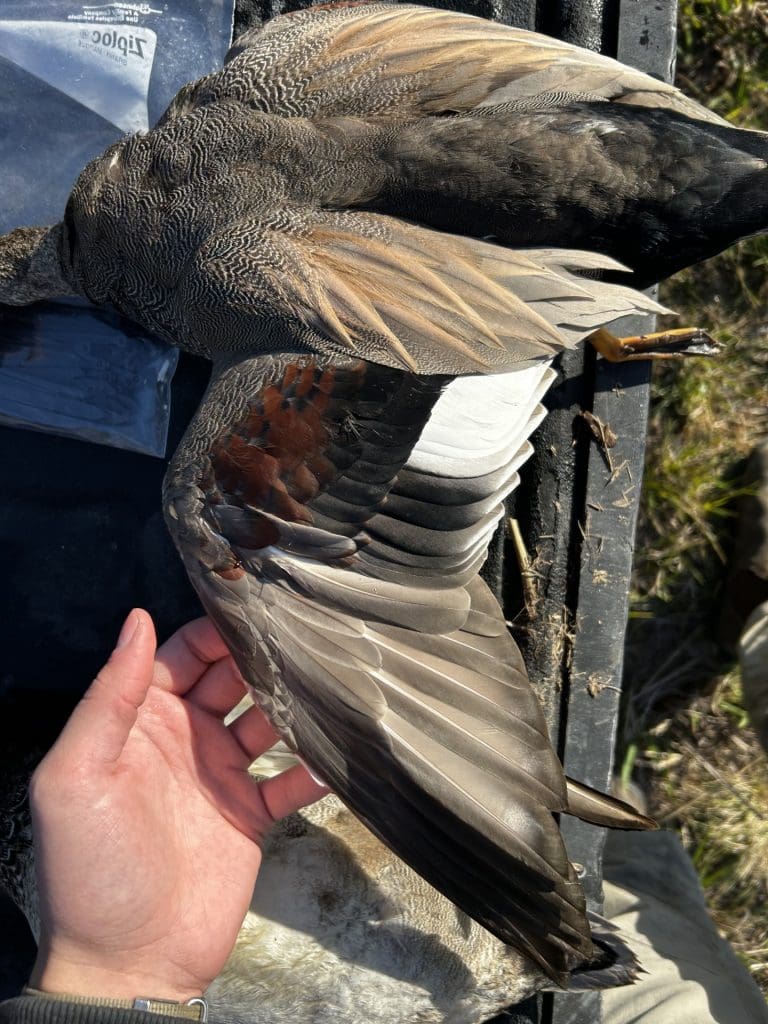
Photo caption: Gadwall wing
If you would like to support our Research program, please click here to donate today.